Lessons from Q1-24

Q1 of 2024 is gone and here are 3 lessons I will carry with me into the next quarter.

Dare to Lead – The Power of Not Taking Shortcuts with People

At the beginning of the year, I delved into Brené Brown’s “Dare to Lead,” which has been an insightful journey. Among its many valuable insights, one particularly resonated with me—the importance of truly understanding and listening to people. Genuine connection often competes for time in my calendar. Yet, authentic leadership demands the investment of time and effort to comprehend and empathize with others, steering away from shortcuts like fear and blame tactics. The latter approach may yield some results, at least temporarily, yet true leadership, the one which inspires teams or organizations toward a shared vision and purpose, yields substantial and enduring outcomes.

The Soft Data – The Power of Not Taking Shortcuts with Customers

Reflecting on this notion of shortcuts, I couldn’t help but draw parallels to the realm of marketing. While tempting, tactics such as price promotions or limited-time offers provide only temporary spikes in metrics, leaving behind the crucial task of understanding “why” customers choose you and “who” you want to be to forge meaningful connections with the right customer. Shortcuts prove counterproductive and ultimately costly, tethering one’s success to market whims. Martin Lindstrom, author of “Buyology” among others, promotes the idea of ‘soft data’, one which is only captured through a deep understanding of the customer.

Bold Moves – The Power of Not Taking Shortcuts by Playing It Safe

Embracing a mindset devoid of shortcuts doesn’t equate to paralysis by analysis or hesitancy in taking action. Bob Iger’s “The Ride of a Lifetime” exemplifies this beautifully through his journey to the helm of Disney. Despite enduring setbacks, he persisted with patience and resilience, ultimately seizing the CEO position and charting a transformative course for the company. His tenure defied conventional wisdom, marked by bold decisions and enduring success—a testament to the power of steadfast leadership.

One more…

Additionally, Jonah Berger’s “Contagious” captivated me with its exploration of the science behind viral ideas. Understanding what drives word-of-mouth dissemination—both online and offline—offers invaluable insights for anyone navigating today’s interconnected landscape.

Lessons from May 2020

There are seven notes and endless ways to play them. There are 24 hours in the day and several ways you can live them. There are varying rhythms making up the pace of life. In the recent months our daily rhythm has been disrupted and we were forced to reconsider a new routine. This was and still is my biggest challenge since we came back to Europe – rebuilding a daily and weekly routine that works for work and for what’s left after that. As disruptive as it is, the blessing is that it is also a time to shape your days rather than follow the mainstream ways of going about life.

As i thought about building a routine that works, three posts appeared on my Facebook feed reminding me three lessons on the topic:

Get down to the detail – The routine behind 21 half marathons in 21 days

My friend and ex-colleague Mark Avery ran 21 half marathons in 21 days. Now that is impressive in itself. Yet the mindset and the routine behind it is even more so. He shared his routine on his Facebook page after those intense 21 days. His routine went into the details of what he did before, during, and after the runs, till the evening, before running another ‘half’ the day after. I followed Mark every day of those 21. I was impressed to see that he kept living a pretty normal life during the three-week-long challenge. He used his midday break to interview runners like him as he raised awareness on mental health. He still clocked in for work. He drank the right things and ate appropriately for the right energy levels the day after. Last but not least he planned his rest and recovery routine in the evening. 

Some of my weeks lately do feel like a marathon everyday. For this reason my focus is on planning a winning routine and make sure that what matters gets done. 

Expect the unexpected – The routine for the creative entrepreneur during Covid-19

Probably, #whileyouweresleeping, Peter Grech was on his bike. Frequently pictures of sunrise pop up on my feed. It’s Peter reminding me to make my mornings count. I spoke to him about how the pandemic disrupted his routine and how he now shapes his days as a father of three and the CEO of BRNDWGN.

He shared with me how some things have not changed even with the unexpected Covid19 reality. He still wakes up early and makes time for training. He manages to have breakfast with the family before hitting his desk by 8.45. As BRNDWGN went remote his work routine now includes regular company check-ins through Zoom on Monday and Wednesday, followed by huddles with his management team. At noon he stops for lunch with his wife and youngest son. He works till 6.30 to walk the dog just before dinner at seven. Friday evening is family Pizza and Cinema night whilst Saturday and Sunday are for outdoor hikes, swims and rides. 

I am totally sold on making mornings count and need no convincing on not skipping breakfast. Even for me this part of the day is a fixed routine. However, next time I skip lunch or dinner, I will remind myself that at least one CEO makes time for these daily and manages to do that with his family. 

First things first – The routine for seeking meaning in life

A routine is a winning routine not only if it helps to get things done by making the most of time, but also if it helps you make time for what is meaningful. Another friend who made it to my Facebook feed was Clive Seychell, a seminarian who during the Covid days had fronted Għallimna Nitolbu, a Facebook page providing resources on prayer. Now you might not be the prayer type but surely you yearn for meaning in life and would benefit with quality time to sort your thoughts out before rushing out to live life. I spoke to Clive on his prayer routine. He shared how he slots his prayer time in the morning, and works backwards from the first appointment of the day to make sure that prayer is the first thing he does. He has a specific place where he spends this solitary first part of the day. The rest of the day follows after that. 

As basic as Clive’s prioritisation hack seems to be, as hard it is to live up to it if you do not take yourself and your lack of time seriously. This is not even a question of starting the harder things first so as not to procrastinate in getting them done. It is a question of doing what matters first. 

As I compose my new daily rhythm on this side of the world, the above examples set clear aims – taking time to plan your day in great detail as if it were a time balance sheet, your goal being to maximize its full potential; expect that your plan will be disrupted, sometimes by things you welcome, other times by the unexpected you’d rather had not happened; and, finally, first things first. 

Photo of one sunrise in Malta taken by Peter Grech

Lessons from April 2020

The last time I spent so much time indoors was back when I had to cram a year’s worth of lecture notes in a few weeks of study. Back then, it felt like everything stopped until my end-of-year exams. 

This time though, work did not stop and my social gatherings made an attempt to happen on a screen. The time I spent in isolation resulted in less structured days and blurred lines between work and family time. As I juggled through life from the same place and through the same screen I learnt that a friend’s time came to an end, following a seven- month-long battle with illness. 

I knew Jonathan Chetcuti through his business partner, Jonathan (Dalli). Thanks to their relationship I was lucky enough to have spent a few moments with him. I am not the first to write about Jonathan (links further down). In this post I wish to talk about the most important  lessons inspired by his approach to work, as told by one man who had him as a colleague, his business partner, and his close friend. Listening to stories about Jonathan’s life at the office I see one consistent theme – a clear sense of the priority of what really matters. 

Think before you speak 

I am reminded of the last time I hastily fired away that email reply, only to regret sending it later. Jonathan’s approach to that email would probably have been different. Had he been in copy he would have told me to go home, sleep over it and reply the next day. Or I go back to that instance where I laboured over a point unnecessarily. Had Jon been in the room he would have suggested I put it behind me and move on. 

‘Decimate’ problems

How do you move on I would ask? That’s one more lesson from Jonathan’s life at the office. The people with whom he worked closely can tell you that he would be able to ‘decimate’ a problem, break it down into smaller parts and then tackle them one after the other. Contrary to that, in corporate life I have often experienced a ‘panic button’ reaction to big challenges. Such a response creates a lot of work, urgency and pressure. It might make one feel like something is being done, but rarely solves the problem in the longer term, only for it to resurface some time later. 

Calmness

It is sometimes tough to hold back and think before I speak. When I manage, it does help me to understand the problem better and focus on the solution, not relying solely on my initial reaction. Even when I succeed in approaching challenges in this way, my default would be the ‘panic button’ approach, with some more drama on top to make sure I drive the point to the people around me. What makes me calmer is seeing the problem in the context of more important and meaningful aspects of my life. Calmness was one of Jonathan’s noticeable traits. Even when he needed to challenge you or reprimand you he would tease it out of a joke. Often you would be the subject of the joke and would clearly get the message and thank him for it. 

This is how this sense of priority runs through the above lessons. Thinking before you speak implies prioritising the outcome more than your ego. Decimating a problem requires doing away with the aspects of a situation which are not the essence of the problem. Staying calm in a challenging situation requires one to think constructively, and prioritise what can be done over the worries about what cannot. Approaching these challenges with this mindset does not devalue the attention we give them; rather it helps us to tackle them calmly. 

I learnt that Jonathan never missed a school run, even when his most important client was visiting from abroad. He would excuse himself, attend to his daily appointment and get back to work. That’s how clearly he prioritised his time.

As we progress through 2020, with challenges that we never expected, let the memory of this fine gentleman fill in the blanks with colour and warmth. Let it also remind us that time is finite, and particularly during this crisis, every minute is an opportunity to inspire those around us as Jonathan did. 

To more meaningful days at the office with a focus on what really matters and the boldness to do away with unnecessary clutter. To more beautiful days in the ‘neighbourhood’ with inspiring stories like Jonathan’s life. 

More articles about Jonathan:

Gege Gatt writes ‘Connecting 7 dots in Jonathan’s life’: https://www.gegegatt.com/jonathan-chetcuti-connecting-7-dots/

Tributes from several friends, not least those he met in sports: https://timesofmalta.com/articles/view/tributes-pour-in-for-volleyball-stalwart-jonathan-chetcuti-who-died.789716

Several close friends and relatives wrote ‘Appreciation: Jonathan Chetcuti’ https://timesofmalta.com/articles/view/appreciation-jonathan-chetcuti.790229

Lessons from March 2020

January was a promise of a fresh page. February was a second chance as the first month of the year drifted away before we had even started to live up to our expectations. Then March came along, and the world changed forever! On top of that, last month we ended our beautiful Australian adventure, relocating earlier than planned, back home. It ended abruptly with a very different farewell than we had ever planned for. However, we will carry the lessons, memories and relationships with us as we get used to this new normal, not just on a different continent, but in a different reality. 

I think it’s fair to dedicate this post to three lessons, three memories and three relationships I will cherish as I look back on almost three years in Australia. 

Three lessons:

“What will you bring to the role after having worked in Australia?”, I was asked.

Top of the list, ‘no drama’, the Australian version of that! I felt that Australian culture really focuses less on the problem and the worry, and more on getting to a solution, whatever it takes.

Secondly, surely a more adventurous self. After living in Australia I would say that if Americans are all about work and Europeans all about art, Australians stand out in being adventurous, “young and free” as they sing, loving the outdoors and beach life!

And finally, living away from home has given us the possibility to live at a slower pace. As hard as that will be when the lockdown is over, I hope to be able to maintain the sense of unhurried life which does away with anxiety, stress and a frenetic heart.

Three memories:

So many of them, but three I wish to hold on to would be:

Landing in Australia – I hope to remember my first evening in the country as a reminder that life is made up of seasons, which offer you the chance to start a fresh page, and that as familiar as they do become, they do come to an end at some point. 

Getting the most expensive fine ever – Yes I did get fined a fair amount in the first few weeks of driving in this new country. I spent the next months trading Facebook time for learning the stricter driving code of conduct. Australia has surely made me less Mediterranean and more disciplined on the road and in other aspects of life. 

A typical morning run which took me over the Sydney Bridge and around the Sydney Opera House. It’s a beautiful scene, especially when the sun is rising over the harbour. Let it remind me to appreciate the beauty around me and to make mornings count. 

Three relationships:

Last but not least I look back on the relationships that came to be. I will cheat here and list three categories. 

Ex-work colleagues that trusted me to join the team in Australia, challenged me along the way and helped me grow. 

The communities we were so lucky to be part of at some point or another. Several of them, mostly related to Church. One which stands out was our son’s school community of parents and teachers. Surely they have made us better people. 

And to conclude, the random relationships that came to be – some we’ve met on random occasions and stuck to all along, some old friends who coincidentally happened to be in Australia at the same time, and work relationships that have evolved outside of the office.

Australia, you will be missed. Promise, we will be back when all this is over. Stay colourful! 

Lessons from February/2020

I have floated through February as the shortest month of the year has been as intensive as its predecessor – at work, at home and around the world. Highlights from last month include family birthday celebrations and the baking of the first ever Spiderman cake in my household! Thankfully, in the last week of the month, I had an excuse to stop and learn some more as I participated in a marketing conference held in Sydney. My top three takeaways from the conference relate to becoming more data-driven when making decisions, making the most of marketing tools and being better in the marketing role. Whilst these lessons might sound like a lot of marketing talk, there’s value in them even beyond the marketing space. 

Making the most of your data

I never realised that the ease by which anyone can access the data is a true measure of how data-driven a team can become. Of course there are other challenges, like the mentality of the team, the ease by which experiments can be conducted and scaled up, and how standardised the definition of success is; however, ease to access data surely makes for strong foundations. 

In practice, if it takes an analyst to write some code to extract the data before we even start understanding it, than that means that every time we start with a data point, we need to wait for an analyst to painfully ‘go up the data mountain’, find the treasure, and come back down with what he assumes is a version of that data which is easy to digest. Several times what he would have come down with is not the only data point we need to get to a decision, and so again we send the poor analyst back up the mountain, wait some more, until we get the right data in hand. In the meantime, other priorities get in the way, and we start the process again. 

Avoiding this painful journey, again and again, is surely a basic foundation towards becoming data-driven. Its existence makes any intent to become data-driven just that, a good intention. 

Making the most of your relationship 

Assuming you got around the first challenge, becoming more data-driven, next is making the most of your systems and tools. One popular tool is the Customer Relationship Management (CRM) system. I was asked to share some thoughts on how to extract the value of a CRM investment. I initially thought about big strategy topics like Lifecycle Management, Customer Lifetime Value, Customer journeys and the likes. Yet, my reflection from several years of work on managing a customer base took me back to the original intent of investing in a CRM tool in the first place – the type and the quality of the relationship a brand wants to establish and lead with. 

In the Telecoms world, until recently, we relied on contracts spanning a year or two, and managed our relationship with the customer accordingly. However old constructs are being overridden and the world moves on. Vodafone in Australia was the first to launch no lock-in contracts which meant that our relationship had to become stronger all along, and not just at the beginning and the end of the two-year commitment. This is just the tip of the iceberg. As switching between one provider to the other becomes easier, connecting with the customer in a personalised and relevant way is a constant effort.

Everything else follows.  

Making the most of your marketing role

Having mastered data like a geek, and the customer relationship like a marketing guru, what next? My favourite session at the conference was the keynote by Alexander Meyer from The Iconic. For those outside of Australia, The Iconic is one of Australia’s most loved brands and is a Sydney-based online fashion and sports retailer. Alexander’s talk was less about The Iconic, and more about the Chief Marketing Officer (CMO) role. 

He started off the talk by asking us what our marketing superpower is, in other words, what we bring to the marketing role we occupy. He presented four types of CMOs – the Creative, the Strategist, the Business Leader and the Techy. Apart from providing several compelling reasons why the CMO role, contrary to some beliefs, is the best place to be in to inspire business, he concluded that for a CMO to be successful, successful enough to make it to a CEO, s/he needs all of the four types of marketing superpowers. 

Of course a CMO needs to be strategic and creative, however the best CMOs also need to talk like a business leader who understands how every single line in the P&L connects to what the team does. In a world where AI & Robotics are changing the business landscape, the next breed of CMOs need to make the most of the new ways of working like a Techy would. Finally they need to have a Growth Mindset and be open to upskill on what is outside of their marketing superpower. 

So if you are not in a marketing role, why is the above still relevant? To start with, in any other role you will be faced with difficult decisions. Making better decisions requires you to know the facts fast and spend less time getting to them. In your role you might not need to invest in expensive marketing tools but you still wish to make the most of your effort, whatever that is. Hence you will be required to question why you intended to make the effort in the first place, and how close you are to achieving the intended result. Finally, becoming better at what you do requires you to go beyond your strengths and think about other aspects to grow in. 

Lessons from January/2020

If the first month of the year had to be a window of what the rest of the year will bring, I will need to take some corrective measures to adjust the rhythm. To my surprise, work and life in January have nicely disrupted the balance I aspired to achieve at the beginning of the year. Nonetheless when I look back at the month I am reminded of at least three instances which I wish to carry with me for the rest of 2020. 

One table which turned into a Flour Shop

At the end of the month we visited Anu and Laura from Flour Shop, previously One Table Sydney. The founders of this shop met in the corporate world and they both left their successful job to follow a dream, first separately, and eventually together, across two continents. We are lucky enough to have followed the team behind this new bakery for the past two years. Visiting them as they were putting their last finishing touches to the new store was surely a good reminder that as hard as it was, being bold enough to follow your instinct pays off. I am sure they had doubts, and I can see that this journey has taken them out of their comfort zone, however they persevered. They have only been open for two weeks now, and from what I hear they are doing great!

Two music acts which set me dreaming 

Last month I was lucky enough to watch two very different artists live. I watched the great Ludovico Einaudi at the majestic Sydney Opera House with my wife and our six-month old. Apart from being happy about having survived the two-hour concert without being kicked out of the venue, I’d like to remind myself how the concert made me feel – pondering on how deep man is, and how alienated busyness can make us. 

Earlier in the month I got to watch Of Monsters and Men, a band from Finland which I have been following for a while. Even though you might not think that you can reflect deeply during a rock concert, well you can! I felt that the band’s approach to the live act fits very well with Australia’s culture – not much drama, just a great act and a sense of young and free – two words which feature in Australia’s anthem. 

Probably the only way to be genuinely young – in how excited and curious you are about life – and free to embrace the adventure and give up your own false expectations, is to really get to know yourself in a deep way. 

Some pages I returned to

In this context it is not surprising that a book I returned to in January has been ‘It Doesn’t Have to Be Crazy at Work’ by David Heinemeier Hansson and Jason Fried. Thankfully I bought this book on Kindle and hence have the convenience of carrying it around with me on my phone. The book is special because it reminds us of the basic priorities on which we should never compromise but which we unfortunately do – being focused at work, not giving up sleep or exercise, holding less meetings and making them count by being present, not answering emails at any opportunity…and many more.   

There should be a time for everything. When it is not crazy (at work or life in general), you have time to journey deep within yourself, and discover what makes you young and free to follow your passion and your calling – making it meaningful and unique. As crazy as some periods I am sure will be, it is this perspective to which I wish to aspire for the rest of the year. Take two, starts in February!

Lessons from December/19

The forest from up high at Illawarra, just a few hours before fires started in Kangaroo Valley, a drive away (own photo)

It feels seriously outdated to look back on the last month of 2019 as we come close to the end of the first month of 2020. Yet this is really testament to the crazy month January has been, at work and outside of it. As one meme said, ‘January is the trial month, 2020 starts in February’. More on that in my next post. 

As I look back on the last few weeks of the past year three things stand out:

Random acts of kindness 

Spending Christmas on another continent, away from family, might get to you. You start questioning why you planned for it to be this way. Thankfully, random acts of kindness like the one we experienced this Christmas make it less difficult. On the eve of Christmas I was asked by a friend if I had any plans for Christmas day, to which I could not hide the lack of any. Next day we were at the family’s Christmas lunch, which included some 30 members of the extended tribe. It was as warm as it was random. The couple were surely paying forward similar acts of kindness they experienced when like us, they lived on the other side of the world for a few years. 

Signing up for uncertainty 

On one evening in December we invited over a friend who just made the big move to Australia for a travelling and working holiday. What stood out for me from the various conversations we had around her plans for this travelling adventure was that she has signed up for uncertainty – although she is a qualified professional, she wants to do none of that during her stay here. If we suggested nice places to get accomodation in the city, she said she just wanted not to be based anywhere and travel. When we got creative on how she could earn some money, she said she was happy to work in return for accomodation and food. There is a season for everything and in this season, this young friend is signing up for uncertainty, by choice. 

Retrospective of a decade 

In 2019 I learnt that one of my top strengths leads me to assess continuously ways in which things can be done better. It is no surprise that at the end of a decade I reflect on how the next one can be better. One great article I stumbled upon to help anyone assess where they’re going, at any time, not just the end of year, is this one.I particularly like the fact that whilst it enlists important things to prioritise, it suggests that if you are too busy to do this, you are busy enough to go off-track. 

So unless you are signing up for uncertainty as our friend, you might want to make time to do the five things in the article mentioned above and, on top of that, add random acts of kindness. Wishing you a great year ahead!

Lessons from November/19

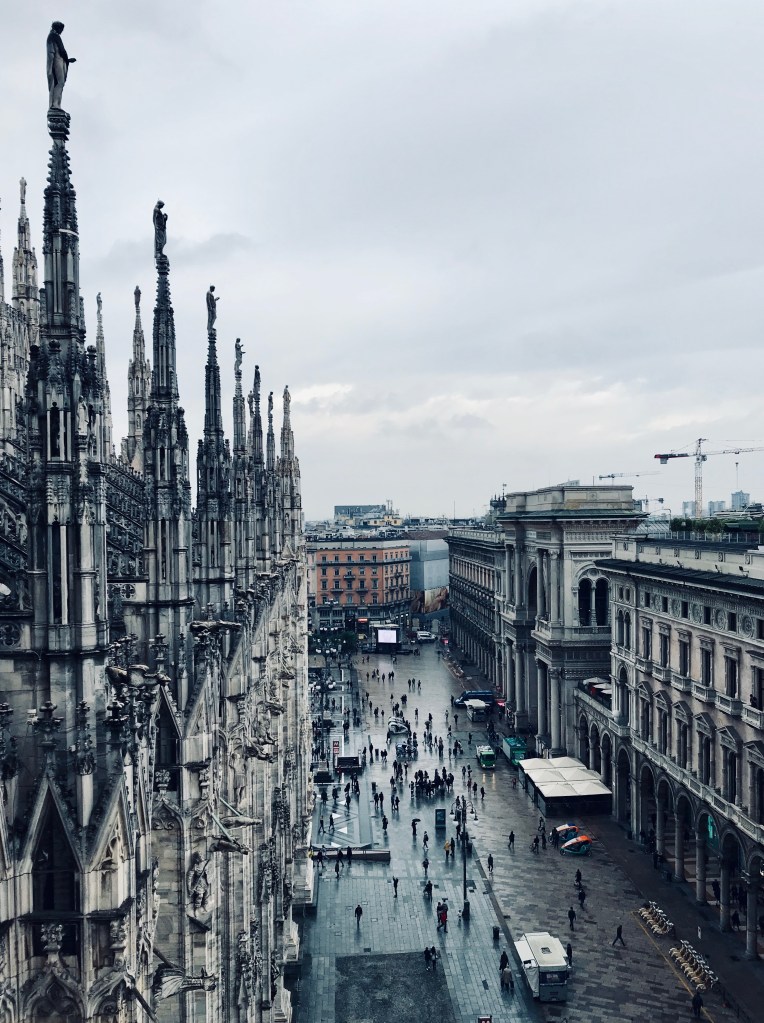
A glimpse of the Duomo’s sculptures from the ground to the sky (own photo)

November was for me a mix of travelling, recovering from jet lag and getting to terms with the political crisis of a small island state which erupted in no small terms towards the end of the month. As I look back on last month, and before I look ahead to the coming year, my thoughts from last month lead me to ask myself three questions:

Who do we want to be?

On one day in November I got lost in Milan. This was not my first visit to the place and I assumed I could find my way around even though my phone battery was almost gone. I had forgotten how beautiful the older parts of Milan are architecturally. The rich architecture is a reflection of who these people wanted to be. It gave me a sense of grandeur and synchrony – buildings sit nicely side by side, all with a similar type of facade that flows from one building to the next. It also reminded me of Milan’s association with design, fashion and style. 

At the same time, Italy’s current political reality is far from in synch. Putting it in context of all the talk around Brexit, and the rise of Populist movements, of which Italy has not been spared, Europeans would struggle to agree on a common identity, on who they really want to be. I couldn’t stop questioning what happened along the way, and what got us here.

What do we stand for?

Milan also prides itself with the Duomo, the 5th largest Christian church in the world. This was the first time I made it inside the magnificent building. Each corner of this building, from the ground to the rooftop, is a work of art. Each sculpture, painting or stained glass window is a bold statement. If you need any convincing of how big a statement the Duomo is just learn more about what constructing it really entailed. It took over six centuries to complete the Duomo and a network of canals had to be constructed to deliver the marble from the quarries. The canals are till today part of Milan’s landscape. 

The scale of the project does reflect what these people wanted to stand for. I doubt any politician or church can justify a project of this scale in our time. Then again we do take hard decisions in the name of economic growth. 

Where do we want to go, (and what aren’t we ready to compromise)?

You do not need to travel much to get to the third place which got me thinking last month. November has been a critical month for Malta. During my brief visit in November things were quite low key. Since I left protesters have taken to the streets almost every other day, demanding resignations of top government officials that in some way, sometimes even by omission, have fuelled a culture of corruption and in the most brutal way shut down the voice of truth amidst all of this, allowing a journalist to be assassinated.

The Maltese will surely not build anything like the Duomo, but this does not mean they haven’t built anything else instead. First and foremost they have built an economy on steroids, the fastest growing in the European Union. Exponential population growth and a massive construction boom are evidence of this. The current administration has a strong mandate to keep delivering on this plan. The direction the country has taken did not come without compromises. Malta, the smallest European state, was until a few years ago known for punching above its weight. Last month It was described as an island of corruption. So is it fair to say that in the name of economic growth we have lost our way, are unclear on what we stand for and confused on who we really want to be? 

The past year has provided several reminders to be true to myself. It started with getting to know more who I am and what I am good at. Then it flowed into harder questions on my purpose, as open ended as that question could be. 

Whether I acknowledge it or not, I do have a ‘Duomo’ in my life – that thing I am excited to commit to with the same dedication of a six century project. What am I willing to give up simply because it gets in the way of what I stand for?

Finally, what am I not willing to compromise? Which are those standards that I am not ready to let go of? How do these line up to my priorities over the coming year?

From all the posts this year, this probably gets the award for the one with the most questions in it. However there is a price to pay for being lazy or alienated enough not to answer these questions, as individuals first and foremost. The crisis that Malta and Europe is going through is primarily a crisis in our heart, and then a societal one. It comes as no surprise that we feel lost, in crisis even. No wonder why we yearn for meaning and deep down we wish to find our way home – the place where we can safely be who we’re designed to be. 

So here’s my challenge for 2020. Whatever my new year resolutions will be, I hope they complement who I want to be a year on from today and reflect what I stand for with no compromise. 

Lessons from October/19

Our baby Zara’s first journey across the globe (own photo)

‘Journeying’ is one word close to my heart. It was very present at the time we decided to relocate to another continent 2 years ago. As I look back on October and the last 10 months of the year I surely consider 2019 to be a year of journeying, more in mindset than in distance. 

Here are three really fundamental lessons from last month which have continued to change my mindset:

Uncovering the journey

Most of my work energy last month was focused on supporting a team of analysts in transition. The journey for us as a team is by no means done. Yet what a luxury it is to look at something with a fresh perspective and uncover where we should go next, doing away with past assumptions to shape the future. We adopted the narrative of moving house, which requires throwing away some stuff (old assumptions and less important tasks), packing the essentials (being clear on the core contribution) and buying new things as you move into the new space (enhancing what you do to make it better and sharper). It is hard work to challenge the way things are done but it’s also the real work to get better. 

Journeying with the most important person 

Speaking of getting better, I finished reading ‘This is Marketing’ by Seth Godin. I recommend the book to anyone, especially those who need to sell what they or their organisation is better at (And who doesn’t?). Several parts of the book stood out for me, one of which is the concluding narrative. It suggests that first and foremost the most important person to market to is yourself. It’s pretty fundamental but often forgotten that people do read through our lack of confidence and conviction. To this extent it is critical to shape a strong personal narrative first and foremost. 

Taking others on the journey

The real journey does not happen until the conviction is externalised and a small group of people start following. One movie I watched last month, whilst travelling back to Europe, was Moneyball. The movie has been around for some time. A key lesson from the movie is not so much the new, data-driven approach adopted to build a winning team with far less budget than the competition. Rather it is the fact that this novel approach only started to bear fruit when the protagonists took the time to share their vision and bring the rest of the team on the same page.

So this is how I journeyed last month, first by supporting a team in transition to uncover the journey, then to market it to myself and, finally the ongoing endeavour of getting everyone else on the same page. 

Lessons from September/19

The “sky snail”​ going down on a long weekend at the Hunter Valley, New South Wales, Australia

October is almost over, so you might ask, “why am I still looking back on September?”. At the beginning of the year I promised myself to share more. Every month so far I have managed to write down what inspired me in the previous month. You might judge me for procrastinating on it this time. I can confess that’s it is really due to a really busy period with little time to recollect my thoughts.

So what have I learnt last month? Work wise I have been encouraged to focus more on ‘the why’ of customer behaviour for some months now. I have dedicated more than a fair share of thought on delving deeper into the why: Why do customers choose this brand or the other? Why do they leave and why do they stay? In this context here are three lessons on the topic. 

3 steps to get to the ‘why’:

One book I started reading in September is The Book of Why by Judea Pearl. One section in the book which I keep returning to is the Ladder to Causation. 

Before it gets too technical, watch this scene from Small Foot. In the scene, Migo’s dad misses the gong. All his life he thought that he was the one causing the sun to come up by sounding the gong. On that morning when he catapulted himself and missed the gong, the sun still come up. He is devastated to learn that it is not his gong causing the sky snake to come up. He shared his feelings with Migo, who is amazed at the discovery. 

For Pearl the first cognitive ability needed to get to the cause is observation. Most insights research is based on observing associations, such as ‘the gong is always heard just before the sun comes up’. Similar observations highlight association but very little on the causal relationship. 

The second ladder rung is doing something about what you observe to understand better the association. One would ask “If I sound the gong, will the sun come up?”. In a different context, “If I take aspirin, will my headache go away?”. That’s a step up the ladder but we’re not fully there yet. Even if my headache does go away, I cannot fully declare that aspirin was the cause. 

That gets us to the third rung, countering the fact through imagination and understanding. “What if I did not have the aspirin, would my headache still have gone away?”. Back to the movie I would ask “if I do not sound the gong will the sun still come up?”.

The promise of machine learning and AI

When we realise how much we do not yet understand the cause and effect relationship of events, particularly human behaviour, we have to also acknowledge how hard it would be for us to get that answer through data science. Why is that so: 

Primarily any machine learning model is trained by humans. The saying “garbage in, garbage out” is most appropriate here. If the input is incomplete, so is the output. I attended AI Experience Conference in Sydney last month. One keynote speaker reported that the vast majority of data models are actually never productionised well enough to give any form of return on investment. Most of them never see the light of day and a chunk of those that do, do not do so in a timely way. By the time some useful insight comes out, the business would have moved on to the next problem.  

Even more of a reason not to hope that a machine can solve what a collection of human brains can’t is the 3 step ladder to causation itself. A machine may be trained to observe associations at a scale and speed beyond what humans can. Machines can also be made to run tests more efficiently than humans can. However the journey to causation requires imagination, retrospection and understanding. As in Small Foot, it requires enough brain power to challenge the facts with counter-facts. As yet, this seems to be far from what machines are able to do!

The emotional side of the ‘why’. 

There was one more statistic which made me realise how hard it is to understand human behaviour, as much as it is fundamental. Humans are emotional beings – 95% of the time they decide based on emotions, the remaining 5% they make a very logical and rational choice. This means that to really understand what causes humans to behave in one way or the other requires us to understand theemotional state accompanying their behaviour. 

This inherently means that even when we manage to get the machine to do the observation, we need to capture as much of the human emotional state as possible. Not surprising that we debate the lack of ‘experience performance indicators’ to properly understand behavioural triggers.

Why is it so important to get to the cause? In the same scene from Small Foot, whilst Migo’s father is devastated to learn that he does not cause ‘the sky snail’ (the sun) to come up, Migo is amazed that “another stone is wrong”, another long standing assumption is being tested. Whilst his dad is scared to ask the question, Migo hopes to discover something even better than what everyone thought they knew. In his own words, “maybe there’s something even better than banging your head against the gong”. 

And there is truly something even better than relying on what we think we know. We just need to stop being the busy gong ringer and start focusing on getting to the why.